

If you’ve been researching full-arch implant solutions, you’ve almost certainly come across both All-on-4 and All-on-6. They sound similar, they achieve the same goal, a fixed, permanent set of teeth, but they’re not identical, and choosing the wrong one for your situation can have long-term consequences.
This blog breaks down the real differences between the two, who each one suits, and how to make the right decision for your mouth, your lifestyle, and your budget, with the help of the specialist team at Trio Dental Center in Albania.
What They Have In Common
Before getting into the differences, it’s worth understanding what All-on-4 and All-on-6 actually share because the similarities are significant.
Both procedures:
- Replace an entire arch of teeth (upper, lower, or both) with a fixed prosthesis
- Use titanium implants anchored into the jawbone as the foundation
- Deliver a permanent, non-removable result — not dentures you take out at night
- Can often be completed with a temporary fixed prosthesis on the same day as surgery
- Eliminate the instability, discomfort, and limitations of traditional removable dentures
- Are available at Trio Dental Center at up to 70% less than equivalent treatment in Italy, the UK, or Germany
The difference comes down to the number of implants used, how the load is distributed, and which patients each approach is best suited to.
What Is All-on-4?
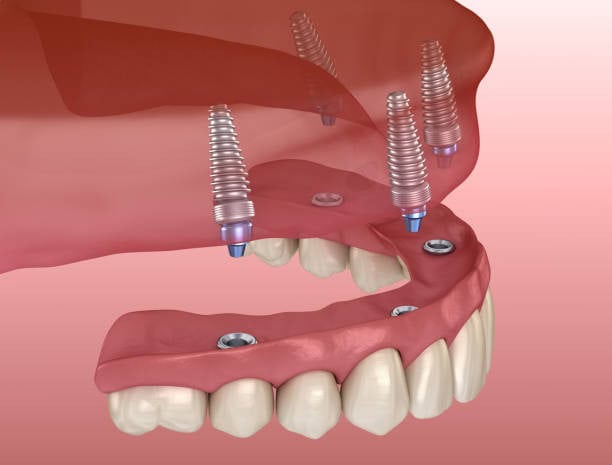
All-on-4 is a full-arch implant solution that uses four strategically placed implants to support a fixed prosthesis of 12–14 teeth. The technique was developed specifically to maximise the use of available bone, particularly in patients who have experienced bone loss.
The key feature of All-on-4 is the angled placement of the two rear implants. Rather than being placed vertically, they are tilted at up to 45 degrees, allowing them to engage a larger volume of bone and avoid anatomical structures such as the sinus cavity in the upper jaw.
This angulation is what makes All-on-4 viable for patients who don’t have enough bone for traditional vertically placed implants.
All-on-4: The Main Advantages
- Fewer implants — less surgical complexity and typically lower cost
- Designed for bone loss — the angled rear implants make it viable even with reduced bone volume, often eliminating the need for bone grafting
- Same-day teeth — a temporary fixed prosthesis is usually placed on the day of surgery
- Shorter procedure time — four implants means less time in the chair
- Well-documented — decades of clinical research and high long-term success rates
What Is All-on-6?
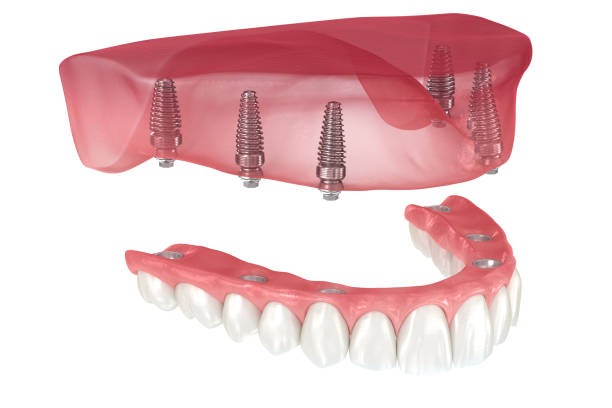
All-on-6 uses six implants to support the same fixed prosthesis, distributing the load across a wider base and providing a more robust foundation for the final restoration.
The additional two implants are typically placed vertically in the mid-arch region, giving the prosthesis more central support. Because six implants are used, All-on-6 generally requires adequate bone volume across a broader area of the jaw, making it best suited to patients with good bone density or those who have undergone bone grafting.
All-on-6: The Main Advantages
- Better load distribution — six implants spread chewing forces more evenly, reducing stress on each individual implant
- Greater stability — particularly for patients with stronger bite forces or who grind their teeth
- More redundancy — the prosthesis is supported by more anchor points, making the overall structure more resilient
- Longer-lasting prosthesis — reduced stress per implant can translate to better long-term performance of the crown and framework
- Better suited to heavier or denser bone — ideal for patients with good bone volume who want the most stable possible outcome
The Key Differences Side By Side
| All-on-4 | All-on-6 | |
| Number of implants | 4 | 6 |
| Implant angulation | 2 angled, 2 straight | Typically all straight |
| Bone requirements | Lower — designed for bone loss | Higher — requires adequate bone volume |
| Bone grafting needed | Rarely | Sometimes, if the bone is insufficient |
| Load distribution | Good | Better |
| Best for | Bone loss, most patients | Strong bone, heavy bite |
| Cost | Lower | Slightly higher |
| Same-day teeth | Yes | Yes |
| Prosthesis | 12–14 fixed teeth | 12–14 fixed teeth |
So Which One Is Right For You?
The honest answer is that this decision should be made by your implantologist after a thorough clinical assessment, not based on a blog post alone. But here is a practical guide to the most common scenarios:
All-on-4 is likely the better fit if:
- You have experienced significant bone loss in the jaw
- You want to avoid bone grafting if possible
- Cost is an important factor, and you want the most affordable full-arch solution
- Your bite forces are normal to moderate
All-on-6 is likely the better fit if:
- You have good bone density and volume across the jaw
- You have a strong bite or a history of bruxism (teeth grinding)
- You want the maximum stability and load distribution available
- You’re willing to invest slightly more for the most robust possible foundation
What about All-on-8?
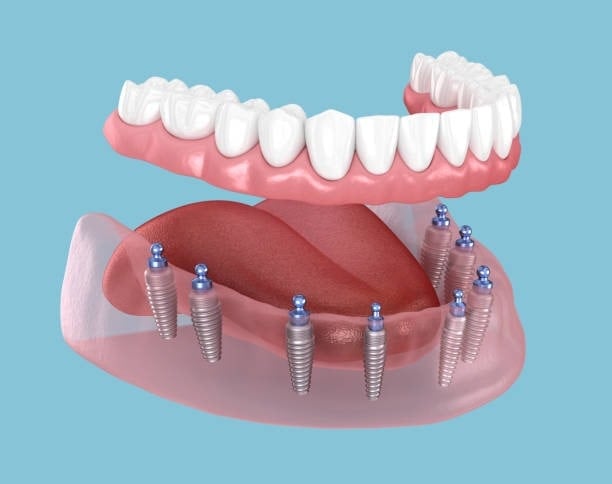
Trio Dental Center also offers All-on-8 eight implants for patients who want the highest level of support available, or whose anatomy and bite particularly benefit from an even wider implant distribution.
At Trio Dental Center, your consultation includes a full 3D CBCT scan of your jaw. This gives our implantologists a precise, three-dimensional picture of your bone volume, density, and anatomy allowing them to recommend with confidence which solution is genuinely right for you, not just which procedure is easier to perform.
Frequently Asked Questions
Will I have teeth immediately after surgery?
Yes. A temporary fixed prosthesis is attached on the same day as implant placement in the vast majority of cases. You leave the clinic with a full set of fixed teeth.
Is the procedure painful?
The surgery is performed under local anaesthesia, and you will not feel pain during the procedure. Post-operative discomfort is well managed with prescribed medication and is typically mild to moderate for the first few days.
How many trips to Albania do I need?
Most patients make two trips, the first for the surgical phase and temporary teeth, and the second (3–6 months later) for the final zirconia prosthesis. Everything in between is monitored remotely.
Can I eat normally with All-on-4 or All-on-6?
Yes — once fully healed. During osseointegration, you follow a soft diet. After the final prosthesis is placed, you can eat most foods comfortably, with the exception of very hard items that should be avoided regardless.
What if I’ve already been told I don’t have enough bone?
This is exactly where All-on-4 is often the ideal solution — its angled implant design is specifically engineered to work with reduced bone volume. In some cases where bone loss is very severe, zygomatic implants may also be an option. Our team will assess your specific situation and give you an honest recommendation.
How long do All-on-4 and All-on-6 last?
The implants themselves are designed to last a lifetime. The zirconia prosthesis typically lasts 15–20 years with proper maintenance before any renewal may be considered.
Book Your Free Consultation
Contact Trio Dental Center
- 📞 Phone: +355 69 747 4695
- 📧 Email: info@dentaltrio.com
- 🌐 dentaltrio.com


 English
  Shqip
Shqip  Italiano
  Français
  Español