
A comprehensive analysis based on internal data from Trio Dental Center and the most authoritative industry sources. Updated figures, trends, and comparisons for those who want to understand—based on facts—why Albania has become Europe’s leading destination for dental care.
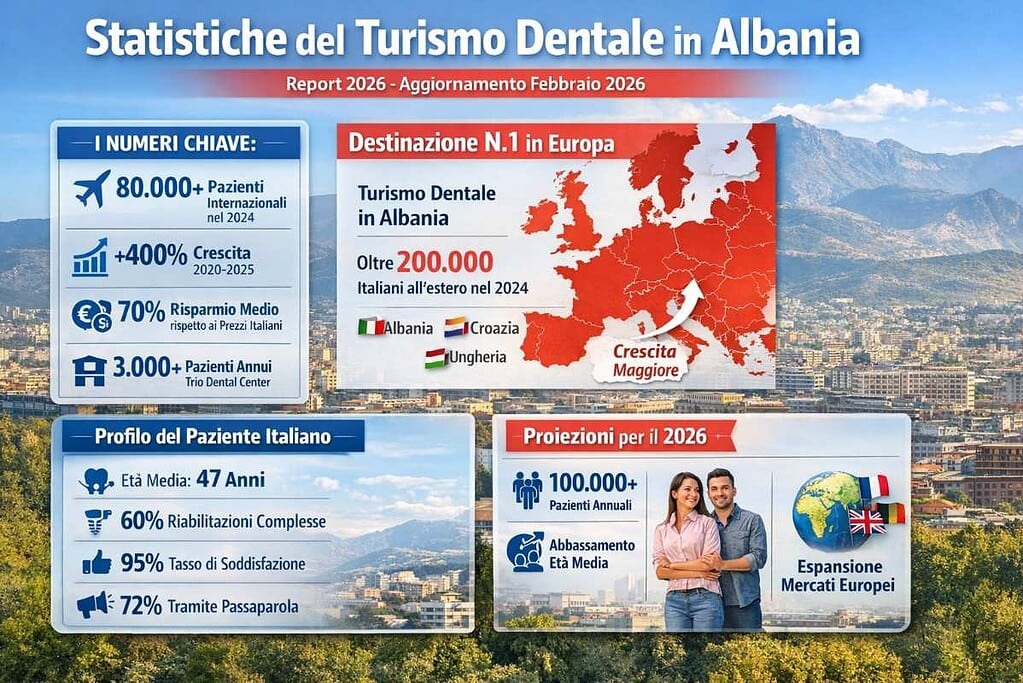
KEY FIGURES
- 80,000+ international patients treated in Albania in 2024
- +400% growth from 2020 to 2025
- Average savings of 70% compared to Italian prices
- 3,000+ patients per year treated at Trio Dental Center
The Growth of Dental Tourism in Albania: Key Numbers
Albania has established itself as the fastest-growing destination in Europe for dental tourism. What was once a niche phenomenon has evolved into a structured, large-scale sector involving tens of thousands of patients each year, with Italy as the primary reference market.
The numbers speak clearly: in 2024, more than 80,000 international patients chose an Albanian clinic for dental treatment—representing 400% growth compared to 2020. Italians make up the largest share, driven by geographic proximity, cultural and linguistic affinity, and a price gap that can reach up to 70%.
200,000+ Italians sought dental treatment abroad in 2024, according to industry estimates. Albania is the fastest-growing destination, overtaking Croatia and Hungary.
The Italian Patient Profile: How It’s Changing
Internal data collected by Trio Dental Center—which welcomes over 3,000 patients annually from Italy, the UK, Germany, and other European countries—shows a significant shift in the Italian patient profile.
- Average age of Italian patients in 2025: 47 years (58 years in 2021)
- Requests for complex full-arch rehabilitations: 60% (35% in 2022)
- Patient satisfaction rate (Trio Dental): 95% (stable since 2023)
- Patients acquired through word of mouth: 72% (55% in 2022)
The most significant change is the drop in average age. In 2021, the typical patient was 58 years old and came out of necessity—often after postponing treatment in Italy for financial reasons. Today, the typical patient is a middle-aged professional or family making a deliberate, planned choice, not a last resort.
At the same time, treatment complexity has increased. 60% of requests now involve full-arch rehabilitations (All-on-4, All-on-6, All-on-8), often requiring two or three stays in Tirana. This clearly indicates growing trust in the quality of Albanian clinics.
Price Comparison: Albania vs Italy, Croatia, and Turkey
Cost remains the primary driver of dental tourism. Below are average prices recorded by Trio Dental Center in Q1 2026, compared with average costs in Italy, Croatia, and Turkey.
- Single implant + crown
Italy: €2,500–3,500 | Croatia: €1,200–1,800 | Turkey: €800–1,400 | Albania (Trio): €650–950 | Savings up to 73% - All-on-4 (single arch)
Italy: €8,000–14,000 | Croatia: €5,000–7,500 | Turkey: €4,000–6,000 | Albania (Trio): €3,200–4,800 | Savings up to 66% - Zirconia crown
Italy: €800–1,200 | Croatia: €350–500 | Turkey: €200–350 | Albania (Trio): €180–280 | Savings up to 77% - Ceramic veneers (each)
Italy: €700–1,000 | Croatia: €350–500 | Turkey: €250–400 | Albania (Trio): €200–300 | Savings up to 71% - Professional whitening
Italy: €300–600 | Croatia: €200–350 | Turkey: €150–250 | Albania (Trio): €100–180 | Savings up to 70% - Bone grafting
Italy: €800–1,500 | Croatia: €500–800 | Turkey: €400–700 | Albania (Trio): €250–450 | Savings up to 70%
Note: Prices in Italy, Croatia, and Turkey are industry averages and may vary by clinic and city. Albanian prices refer specifically to Trio Dental Center, Tirana.
Why Albania Has Overtaken Croatia: Structural Advantages
Albania’s rise over Croatia as the preferred destination for Italians is not accidental. It is driven by a combination of structural factors that make Albania’s competitive advantage difficult to replicate.
1. Lower operating costs
Following Croatia’s entry into the EU and Schengen Area, operating costs for clinics increased significantly, eroding price advantages. Albania maintains a much lower cost of living, translating into treatment prices 30–40% lower even than Croatia.
2. Widespread Italian language proficiency
Clinic staff in Albania commonly speak fluent Italian—a result of decades of cultural proximity. In Croatia, communication is primarily in English, which remains a real barrier for many Italian patients, especially older ones.
3. Air connectivity
Direct flights from Rome, Milan, Bologna, Venice, Naples, and other Italian cities reach Tirana in under two hours, often for less than €100 round-trip with low-cost airlines.
4. Infrastructure investment
Major road projects have reduced travel times from Tirana Airport to the coast and other cities by around 40%, making it easier to combine treatment with leisure travel.
Where Patients Come From: Nationality Breakdown
According to Trio Dental Center’s internal data, the distribution of international patients in 2025 was:
- 🇮🇹 Italy — 58%
- 🇬🇧 United Kingdom — 18%
- 🇩🇪 Germany — 10%
- 🇫🇷 France — 6%
- 🌍 Other countries — 8%
Italy accounts for nearly 60% of all patients, confirming its dominant role in Albania’s dental tourism market. The UK is the second-largest market, driven by even larger price differentials compared to the British system.
Most Requested Treatments by Italian Patients
Analysis of treatment requests at Trio Dental Center in 2025 shows a clear shift toward more complex procedures:
- Dental implants — 38%
- All-on-4 / All-on-6 — 28%
- Crowns and bridges — 18%
- Dental veneers — 10%
- Other treatments — 6%
Implantology—both single implants and full-arch solutions—accounts for 66% of all requests, confirming that Italian patients primarily travel to Albania for high-value procedures where savings are most substantial.
The Tourism Effect: Patients Return as Tourists
One of the most interesting findings concerns post-treatment behavior. According to an internal survey of 800 Italian patients conducted by Trio Dental Center in 2025:
- 67% said they would return to Albania for vacation
- 41% actually returned within 12 months (not for treatment)
- 89% rated their overall experience in Albania positively
- 4.7/5 average rating for Albanian hospitality
“Most Italian patients arrive with an outdated perception of Albania. After just a few days in Tirana, they discover a modern, vibrant city with an excellent food scene. Many tell us, ‘We’ll come back for a holiday.’ And many actually do.”
— Trio Dental Center, Patient Observatory 2025
The Albanian Riviera—from Vlorë to Sarandë via Ksamil—is increasingly compared to Croatia 20 years ago: beautiful beaches, affordable prices, and authentic hospitality. Improved road infrastructure now allows patients to reach the coast in under two hours from Tirana, making it easy to combine medical care with a holiday.
Projections and Trends for 2026–2027
Based on current data and observed market dynamics, expected trends over the next 12–24 months include:
- Continued volume growth: Albania is expected to exceed 100,000 international dental patients in 2026, driven by word of mouth and increased media exposure.
- Further decrease in average age: The 35–45 age group is growing fastest, with strong interest in aesthetic dentistry (veneers, whitening) alongside implantology.
- Stronger regulation: Government investment in healthcare regulation—also linked to Albania’s EU accession path—will raise standards for clinics serving international patients, eliminating unqualified operators.
- Expansion of source markets: Beyond Italy, significant growth is expected from the UK, Germany, and France, where price differentials remain substantial.
📋 Methodological Note
The data presented on this page comes from two primary sources:
- Internal data from Trio Dental Center, based on patient records and satisfaction surveys conducted in 2024–2025;
- Industry estimates published by independent sources, including specialized media and European medical tourism reports.
Internal data refers specifically to Trio Dental Center’s patient base and is not necessarily representative of the entire Albanian market. This page is updated quarterly.


 English
  Shqip
Shqip  Italiano
  Français
  Español